For years, the blockchain industry has returned to the same framing: the trilemma between security, decentralization, and scalability. Every serious network has had to decide where it sits on that triangle. But post-quantum cryptography is introducing a harder and more urgent version of the problem.
The next generation of blockchains will not only need to be secure, decentralized, and fast. They will need to be quantum-secure, private, and scalable at the same time. That is a different design challenge. It is not a simple matter of swapping one signature scheme for another. It changes the weight of every transaction, the shape of every wallet, and the assumptions behind every scaling system.
This is the new blockchain trilemma: quantum security, privacy, and scalability. Solving any one side in isolation is possible. Solving all three together is where the real engineering begins.
The Original Trilemma Was Only the Beginning
The classic blockchain trilemma asks whether a network can maximize three properties at once: security, decentralization, and scalability. A highly decentralized network may be harder to scale. A high-throughput system may depend on infrastructure that fewer participants can run. A secure network may accept performance limits in exchange for stronger guarantees.
That framework still matters. But it was built around the cryptographic assumptions of the pre-quantum era. Most existing chains rely on signature systems that are compact, efficient, and widely deployed, but not designed to withstand a sufficiently powerful quantum computer. As quantum computing advances, the question is no longer whether blockchains should prepare. The question is what preparation actually costs.
Quantum Security Makes Transactions Heavier
Digital signatures are the foundation of blockchain ownership. They prove that the person spending funds controls the relevant private key. Today, many networks use signatures that are small enough to fit comfortably inside transaction formats and block limits.
Post-quantum signatures change that equation. They are designed to remain secure against quantum-capable attackers, but they are much larger than the signatures blockchains commonly use today. A typical Bitcoin ECDSA signature is roughly 70 bytes. NIST’s ML-DSA-87 signature is around 4,627 bytes. That is roughly a 70-fold increase in signature size.
This is not a cosmetic difference. Blockchains are constrained systems. Every byte propagated across the network must be stored, verified, and transmitted by nodes. If each transaction carries dramatically more signature data, the chain can process fewer transactions under the same blockspace and bandwidth assumptions.
Post-quantum security is stronger cryptography, but it is also heavier cryptography. The upgrade improves resilience while putting new pressure on throughput and infrastructure.
Privacy Cannot Be an Afterthought
Quantum-secure signatures protect ownership, but they do not automatically protect privacy. A blockchain can be resistant to quantum attacks and still reveal the full payment graph: who paid whom, when, and how much. For users, institutions, and applications that require confidentiality, that is not enough.
True transaction privacy requires a network to prove validity without exposing unnecessary information. The system must be able to confirm that funds are legitimate, balances are preserved, and rules are followed, while hiding sensitive transaction details from public view.
That usually means additional cryptographic work. Privacy systems often rely on commitments, proofs, nullifiers, encrypted data, or other mechanisms that make transactions more complex. The result is a second layer of pressure on the chain. Privacy improves user protection, but it also adds computational and data overhead that the network must absorb.
Scalability Has to Carry Both Burdens
Scalability is where the new trilemma becomes unavoidable. Larger post-quantum signatures reduce transaction density. Privacy systems add more cryptographic material and verification complexity. If a network tries to place all of that directly onchain without changing its architecture, throughput suffers.
In practical terms, a block filled with large post-quantum signature and key material can carry far fewer transactions than a block using compact legacy signatures. Add privacy-preserving transaction data on top, and the pressure becomes even greater.
The cost is not hypothetical. When Solana benchmarked post-quantum signatures with Project Eleven in early 2026, throughput dropped by roughly 90 percent. That figure is a warning to every network weighing a retrofit: swapping in quantum-secure signatures without rethinking the underlying architecture can collapse the very performance users depend on.
This is why zero-knowledge proofs keep appearing in serious post-quantum blockchain designs. Instead of forcing every heavy signature and every verification step onto the base layer, a system can verify transactions elsewhere and settle a compact proof onchain. Many transactions can be compressed into one proof, reducing the burden on the network.
But there is an important caveat: not every zero-knowledge system is quantum-safe. If the proof system relies on assumptions that quantum computers can break, it may undermine the very security upgrade it was meant to support. Post-quantum scaling requires proof systems chosen with the same threat model in mind.
The New Trilemma in One Frame
- Quantum security protects ownership against future quantum attacks, but larger signatures increase transaction weight.
- Privacy protects users from surveillance and payment-graph analysis, but it adds cryptographic overhead.
- Scalability must preserve throughput while carrying the combined cost of stronger signatures and private transactions.
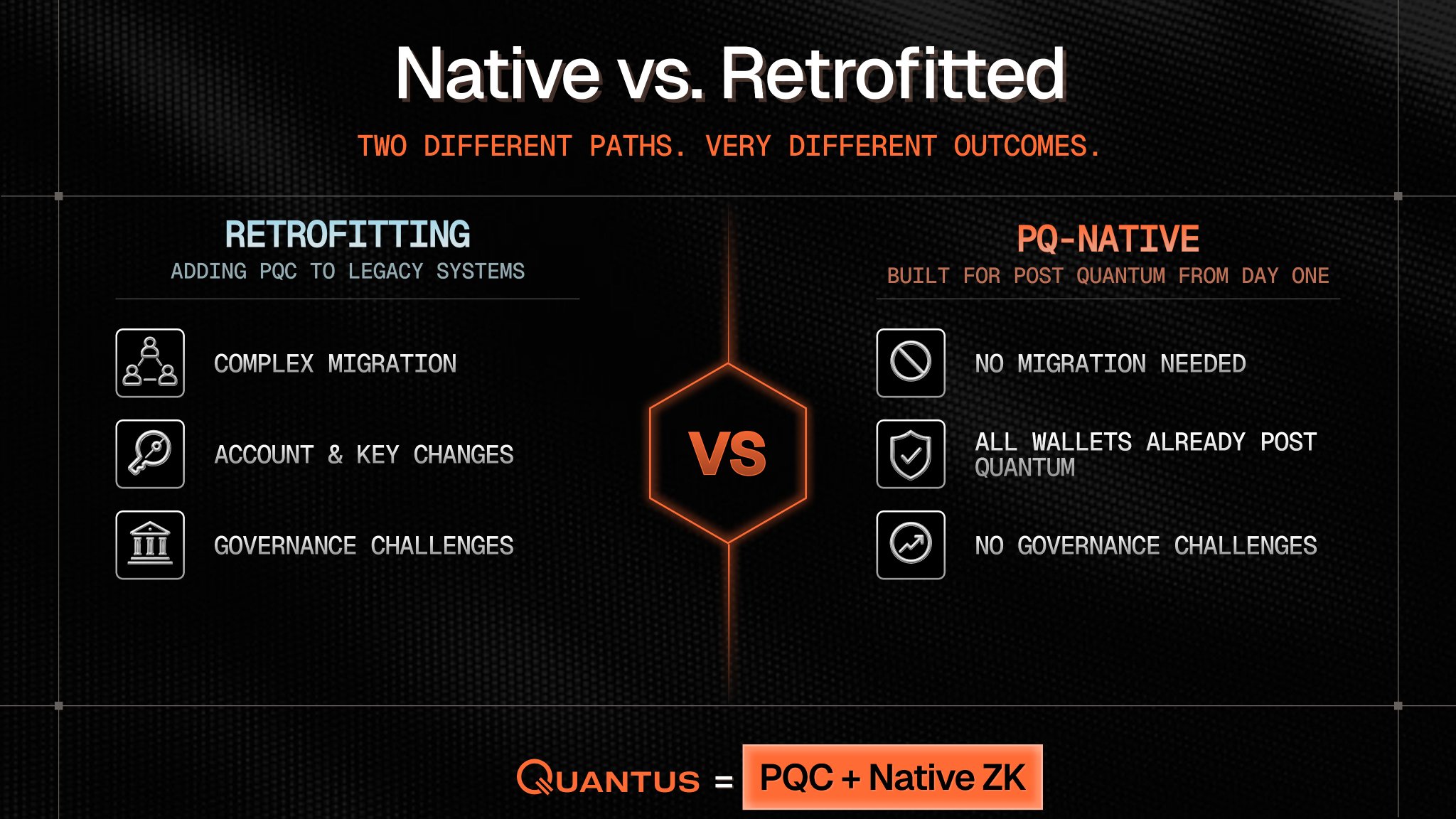
This is why retrofitting post-quantum security into a live chain is so difficult. It is not just a signature migration. It touches account models, address formats, wallets, infrastructure, node requirements, proof systems, transaction flows, custody tooling, and user experience. Every layer has to change without breaking the system people already depend on.
Why Genesis-Level Design Matters
Quantus argues that the new trilemma should be treated as a founding constraint, not a future patch. Its architecture was designed around post-quantum requirements from genesis, combining ML-DSA-87 for quantum-secure signatures, recursive STARKs for quantum-resistant scaling, and Wormhole for private post-quantum transactions.
The point is not simply that one component is stronger than another. The point is that the components have to fit together. Quantum-secure signatures create heavier transactions. Privacy requires additional cryptographic structure. Scaling must compress and verify that activity without reintroducing quantum-vulnerable assumptions. If those constraints are considered only after a network is already live, the trade-offs become much harder to manage.
Designing from genesis allows a blockchain to make the hard decisions early: how transactions are represented, how proofs are generated, how wallets behave, how private transfers are verified, and how the base layer remains usable as cryptographic requirements grow.
The Stakes for the Next Era of Blockchains
The post-quantum transition will not be judged only by whether a chain can claim quantum resistance. It will be judged by whether that resistance survives contact with real usage. Can the network remain private? Can it scale? Can users interact with it without carrying the complexity themselves? Can infrastructure operators support the added cryptographic load?
Those questions define the next era of blockchain design. Stronger signatures are necessary, but they are not sufficient. Privacy is necessary, but it must be engineered into the system rather than added as an expensive accessory. Scalability is necessary, but it cannot depend on assumptions that fail under the same quantum threat model the chain is trying to address.
The classic trilemma forced blockchains to confront trade-offs between openness, resilience, and performance. The new trilemma forces them to confront an even deeper question: can a network remain secure in the future while still being private and usable at scale today?
That is the challenge Quantus is positioning itself to solve. And if quantum risk continues to move from theory toward engineering reality, it may become one of the most important design tests in crypto.